
Finding the Source Intrusion and Optimizing Drill Planning with Reyna Silver
The Guigui Project
The Guigui Project is a this is a link example in content silver prospect in Chihuahua, Mexico in the historic Santa Eulalia mining district. It neighbors some of the biggest silver mines in Mexico.
Heading 2 Example
Lorem ipsum dolor sit amet, consectetur adipiscing elit. Nunc tincidunt bibendum quam quis accumsan. Nulla facilisi. Proin sagittis, nunc a lobortis tincidunt, ex justo blandit risus, quis rutrum tortor urna id ligula. Duis vitae ex eget diam mattis viverra. Vestibulum vel purus id mi ultricies vulputate elementum et ligula. Maecenas libero sapien, gravida vitae dapibus non, viverra at justo. Vestibulum efficitur id justo vel pharetra. Aenean eget sapien augue.
Heading 3 Example
Lorem ipsum dolor sit amet, consectetur adipiscing elit. Nunc tincidunt bibendum quam quis accumsan. Nulla facilisi. Proin sagittis, nunc a lobortis tincidunt, ex justo blandit risus, quis rutrum tortor urna id ligula. Duis vitae ex eget diam mattis viverra. Vestibulum vel purus id mi ultricies vulputate elementum et ligula. Maecenas libero sapien, gravida vitae dapibus non, viverra at justo. Vestibulum efficitur id justo vel pharetra. Aenean eget sapien augue.
Heading 4 Example
Lorem ipsum dolor sit amet, consectetur adipiscing elit. Nunc tincidunt bibendum quam quis accumsan. Nulla facilisi. Proin sagittis, nunc a lobortis tincidunt, ex justo blandit risus, quis rutrum tortor urna id ligula. Duis vitae ex eget diam mattis viverra. Vestibulum vel purus id mi ultricies vulputate elementum et ligula. Maecenas libero sapien, gravida vitae dapibus non, viverra at justo. Vestibulum efficitur id justo vel pharetra. Aenean eget sapien augue.
Heading 5 Example
Lorem ipsum dolor sit amet, consectetur adipiscing elit. Nunc tincidunt bibendum quam quis accumsan. Nulla facilisi. Proin sagittis, nunc a lobortis tincidunt, ex justo blandit risus, quis rutrum tortor urna id ligula. Duis vitae ex eget diam mattis viverra. Vestibulum vel purus id mi ultricies vulputate elementum et ligula. Maecenas libero sapien, gravida vitae dapibus non, viverra at justo. Vestibulum efficitur id justo vel pharetra. Aenean eget sapien augue.
Heading 6 Example
Lorem ipsum dolor sit amet, consectetur adipiscing elit. Nunc tincidunt bibendum quam quis accumsan. Nulla facilisi. Proin sagittis, nunc a lobortis tincidunt, ex justo blandit risus, quis rutrum tortor urna id ligula. Duis vitae ex eget diam mattis viverra. Vestibulum vel purus id mi ultricies vulputate elementum et ligula. Maecenas libero sapien, gravida vitae dapibus non, viverra at justo. Vestibulum efficitur id justo vel pharetra. Aenean eget sapien augue.
Callout Example
Callout example, uses the existing header styles, and assumes that typical use will be an h2 and copy or just copy. Lorem ipsum dolor sit amet, consectetur adipiscing elit. Nunc tincidunt bibendum quam quis accumsan. Nulla facilisi. Proin sagittis, nunc a lobortis tincidunt, ex justo blandit risus, quis rutrum tortor urna id ligula. Duis vitae ex eget diam mattis viverra. Vestibulum vel purus id mi ultricies vulputate elementum et ligula. Maecenas libero sapien, gravida vitae dapibus non, viverra at justo. Vestibulum efficitur id justo vel pharetra. Aenean eget sapien augue.
Callout Example
Secondary Calllout example, uses reduced header size, and assumes that typical use will an h2 and copy. Lorem ipsum dolor sit amet, consectetur adipiscing elit. Nunc tincidunt bibendum quam quis accumsan. Nulla facilisi. Proin sagittis, nunc a lobortis tincidunt, ex justo blandit risus, quis rutrum tortor urna id ligula. Duis vitae ex eget diam mattis viverra. Vestibulum vel purus id mi ultricies vulputate elementum et ligula. Maecenas libero sapien, gravida vitae dapibus non, viverra at justo. Vestibulum efficitur id justo vel pharetra. Aenean eget sapien augue.
List Examples
Unordered List
- Unordered list item 1
- Unordered list item 2
- Unordered list, longer item example 3
Ordered List
- Ordered list item 1
- Ordered list item 2
- Ordered list, longer item example 3
Button Examples
Lorem ipsum dolor sit amet, consectetur adipiscing elit. Nunc tincidunt bibendum quam quis accumsan. Nulla facilisi. Proin sagittis, nunc a lobortis tincidunt, ex justo blandit risus, quis rutrum tortor urna id ligula. Duis vitae ex eget diam mattis viverra. Vestibulum vel purus id mi ultricies vulputate elementum et ligula. Maecenas libero sapien, gravida vitae dapibus non, viverra at justo. Vestibulum efficitur id justo vel pharetra. Aenean eget sapien augue.
Lorem ipsum dolor sit amet, consectetur adipiscing elit. Nunc tincidunt bibendum quam quis accumsan. Nulla facilisi. Proin sagittis, nunc a lobortis tincidunt, ex justo blandit risus, quis rutrum tortor urna id ligula. Duis vitae ex eget diam mattis viverra. Vestibulum vel purus id mi ultricies vulputate elementum et ligula. Maecenas libero sapien, gravida vitae dapibus non, viverra at justo. Vestibulum efficitur id justo vel pharetra. Aenean eget sapien augue.
Two Column Example
Column 1
Lorem ipsum dolor sit amet, consectetur adipiscing elit. Nunc tincidunt bibendum quam quis accumsan. Nulla facilisi. Proin sagittis, nunc a lobortis tincidunt, ex justo blandit risus, quis rutrum tortor urna id ligula. Duis vitae ex eget diam mattis viverra. Vestibulum vel purus id mi ultricies vulputate elementum et ligula. Maecenas libero sapien, gravida vitae dapibus non, viverra at justo. Vestibulum efficitur id justo vel pharetra. Aenean eget sapien augue.
Column 2
Proin sagittis, nunc a lobortis tincidunt, ex justo blandit risus, quis rutrum tortor urna id ligula. Duis vitae ex eget diam mattis viverra. Vestibulum vel purus id mi ultricies vulputate elementum et ligula. Maecenas libero sapien, gravida vitae dapibus non, viverra at justo. Vestibulum efficitur id justo vel pharetra. Aenean eget sapien augue.
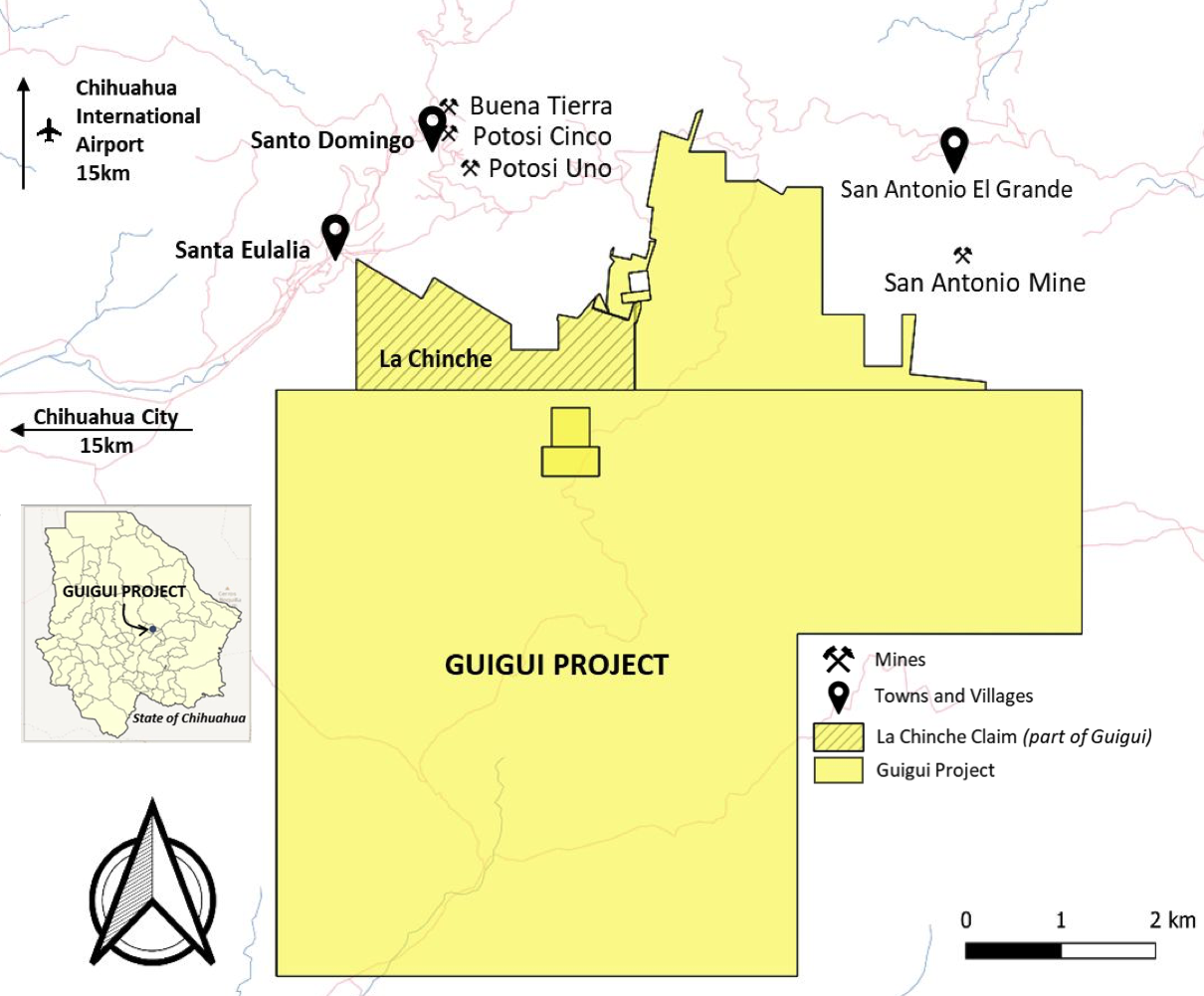
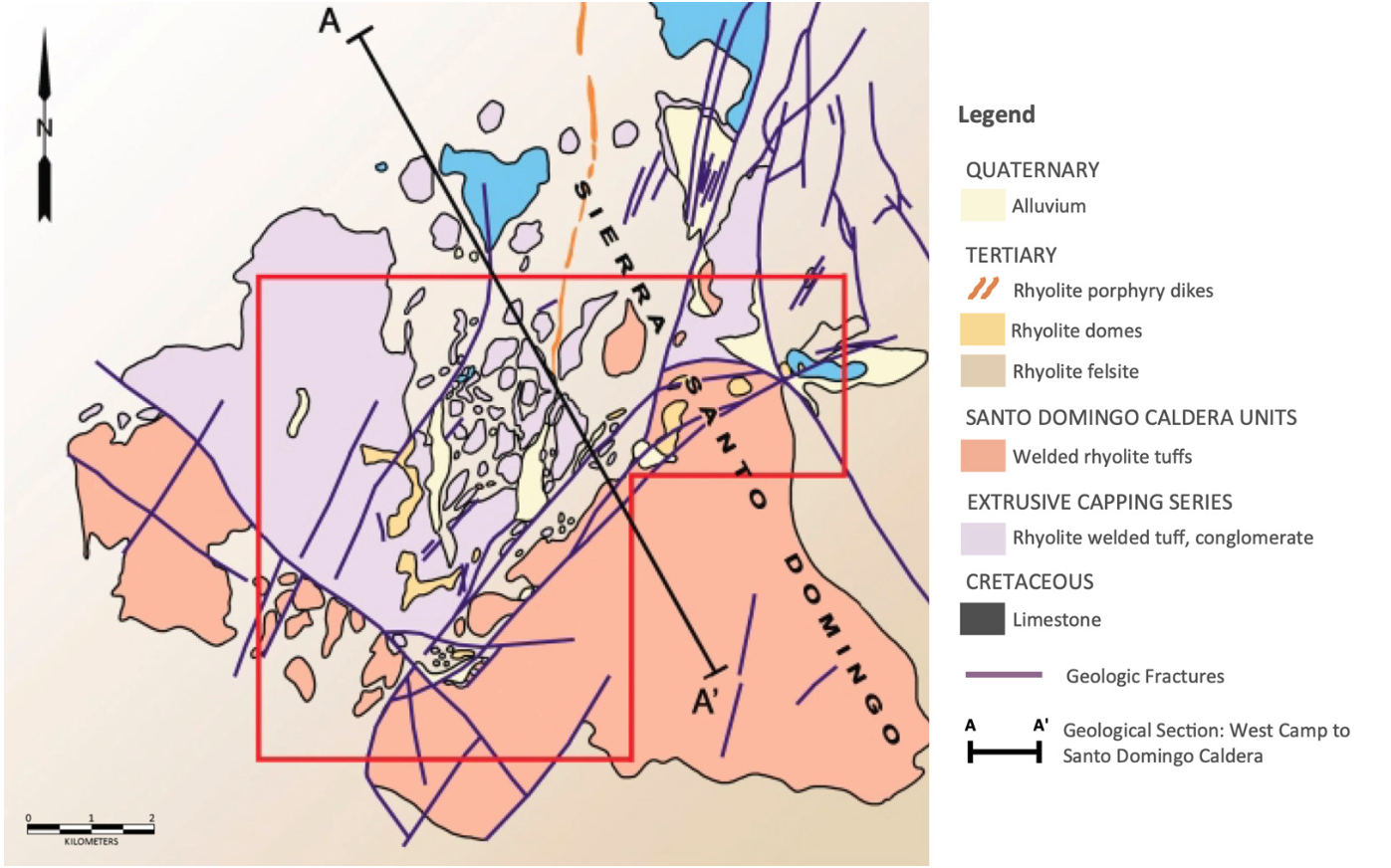
The southern part of the Guigui property contains a large caldera, a remnant of a time when this property experienced volcanic activity. As such, there is a 300-500m layer of volcanic tuff blanketing large parts of the surface in the northern parts of the property. Below the volcanics is a thick layer of carbonates, which hosts most of the historic mineralization in the region. Mineralization is typically found as carbonate replacement deposits (CRDs), which are formed when hot, acidic fluids created by volcanic activity react with the basic carbonate rocks to precipitate highly concentrated sulfide minerals like X, Y, and Z.
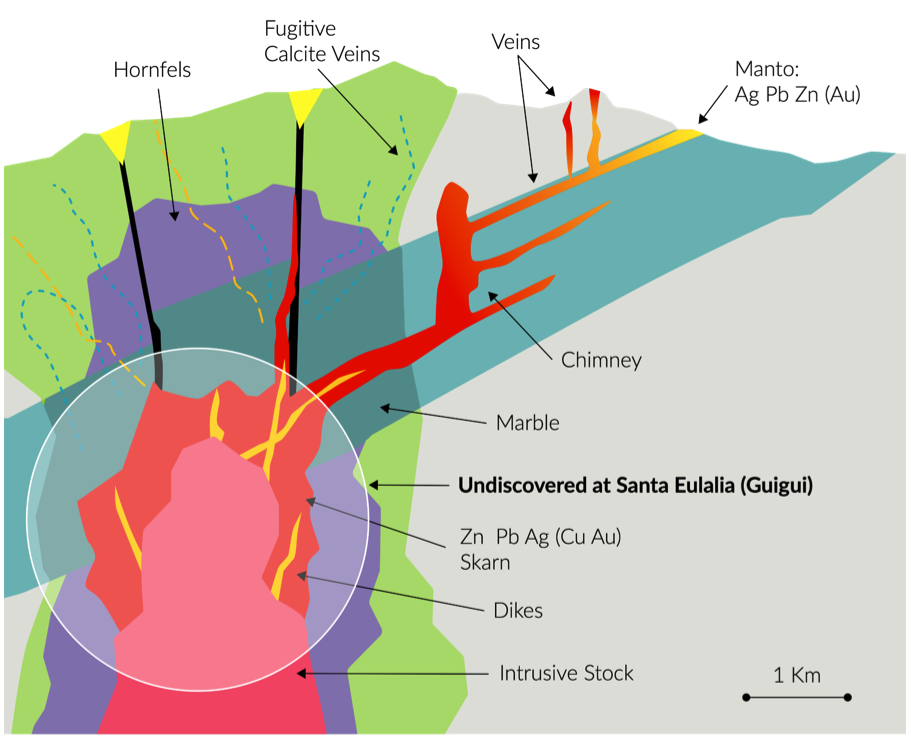
Multiple styles of carbonate replacement deposits can exist within a larger mineralizing system. This historic deposits in the Santa Eulalia district display characteristics of a distal style of mineralization, meaning that the source porphyry, which is thought to control the mineralization of the entire region, remains to be discovered. Given that the known distal deposits are already huge, it stands to reason that there's an even bigger system co-located with the source porphyry.
ExploreTech was brought in to help vector in on the source porphyry using geophysical data.
Magnetic Anomalies: A Vector for Silver Mineralization?
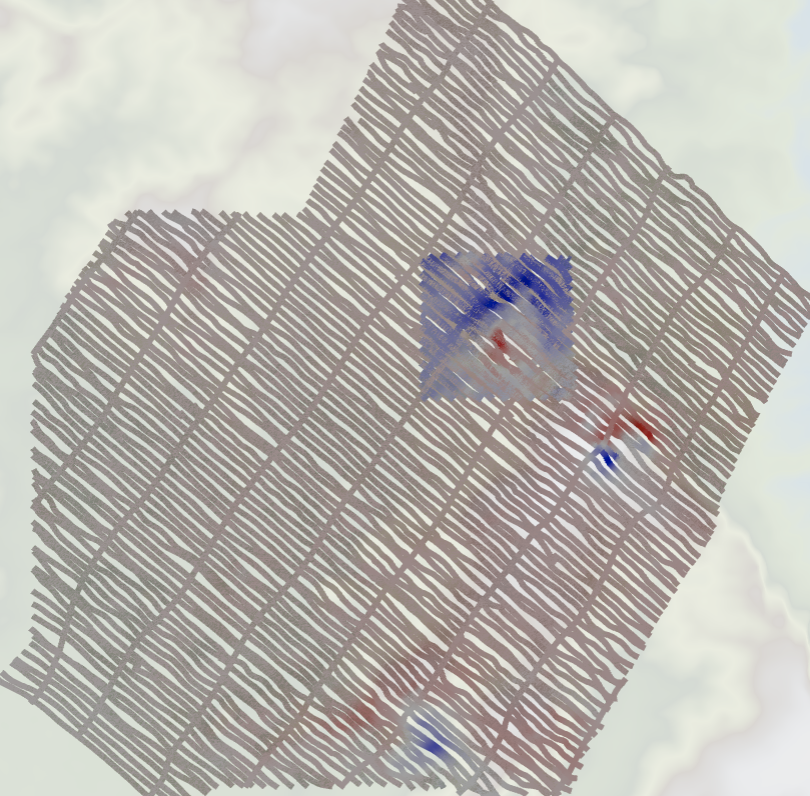
The Guigui project contains several layers of geophysics, including airborne magnetics data. There are lots of ways to display magnetics data, and Figure 4 below shows the data as lines colored by the total magnetic intensity on a blue-white-red color scale.
Porphyritic systems, like the one at Guigui, can create magnetic anomalies in a variety of ways:
- Magnetic minerals, like magnetite or titanomagnetite, forming in intermediate or mafic magmas.
- Deposition of additional magnetite or pyrrhotite during the carbonate replacement deposit acid-base reactions.
- Hydrothermal alteration can also destroy primary magnetite, creating magnetic lows or "quiet zones" in the magnetic signature. Particularly phyllic (sericitic) and advanced argillic alteration.
For all these mechanisms, the magnetic signature is composed of two sources of magnetization: induced magnetization and remanent magnetization. Induced magnetization comes from Earth's natural mangetic field interacting with magnetic rocks to create a secondary magnetic field, which we can measure. Remanent magnetization refers to a magnetic signature in the rocks themselves, which was "locked in" ever since the magnetic minerals formed. What's important is that both of these signatures can be present and overlapping, making it really complex to interpret magnetic data.
Zooming out, the most important thing is that if we know what causes the magnetic signatures, we can get clues about where to find the (ideally economic) mineralization. And if we get extremely lucky, the magnetic signature could be directly caused by economic mineralization.
Imaging the Guigui Magnetic Anomaly
After reviewing the magnetic dataset and discussing with Reyna Silver's fantastic team of geologists, we settled on investigating one of the smaller, more subtle anomalies.
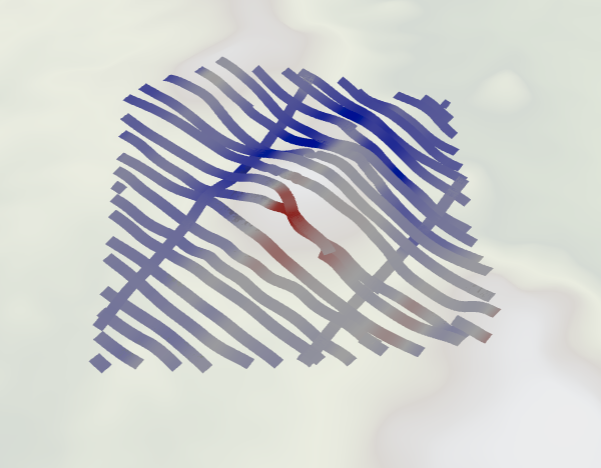
This anomaly is situated around a promininent hill, with the magnetic high on the southwest part, and the magnetic low on the northeast part. We know from the geological studies that the hill is primarly made of volcanic tuff, and that the carbonates of interest lie beneath that layer. Therefore, we settled on using a simplified geological model consisting of a layer and an ellipsoid. After assigning bounds to the location, shape, size, and physical properties of each model component, we can visualize this initial guess by bouncing through all the possible models.
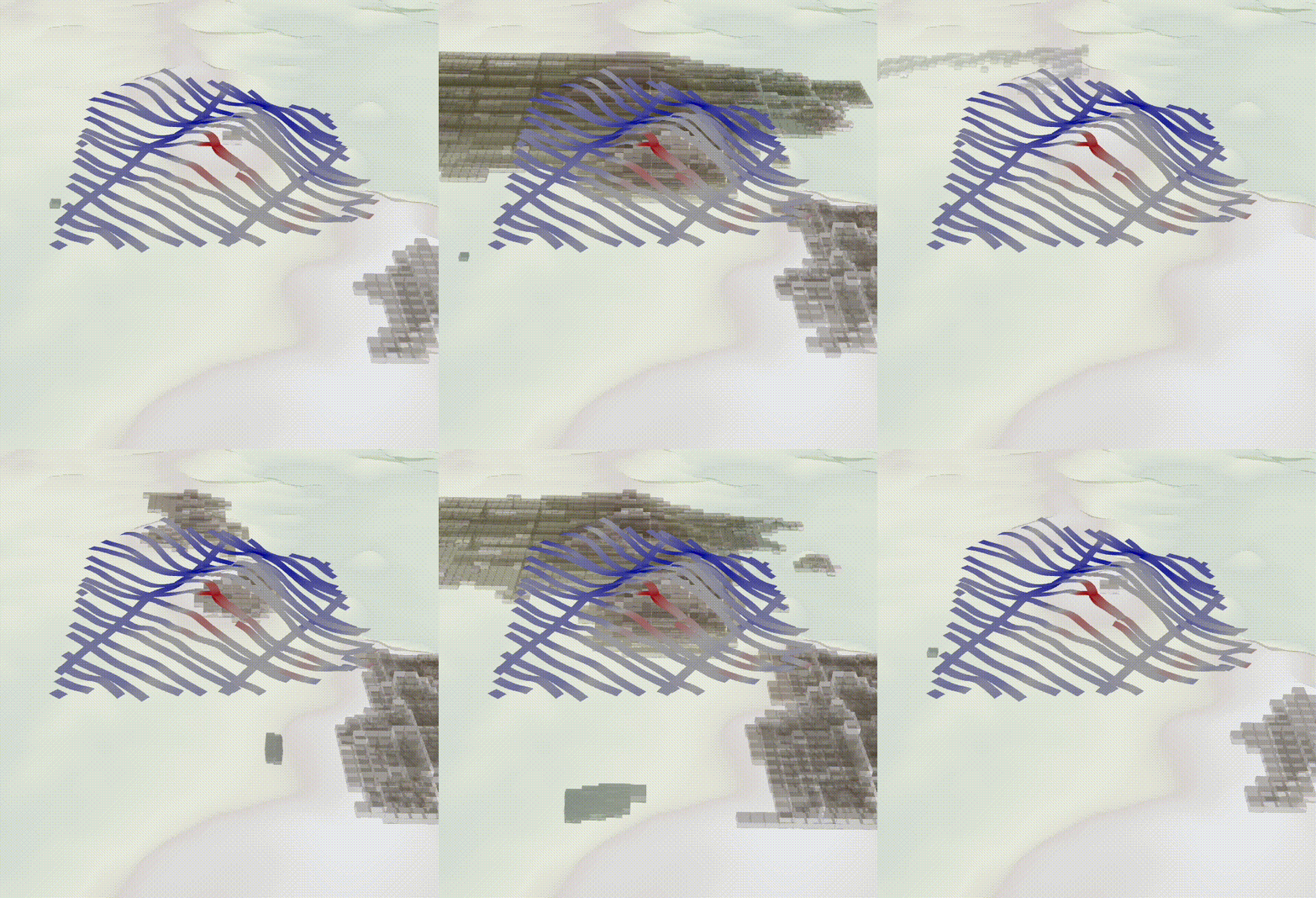
Next we constrain it to the magnetic data. We do this by running tens of thousands of forward magnetic simulations and gradually refining the model. For the algorithms people out there, this is a type Sequential Monte Carlo. The animation below shows the model parameters (left) and simulated magnetics (right) being iteratively improved. Overall, this process takes about a week of letting the computers run on the ExploreTech Engine platform.
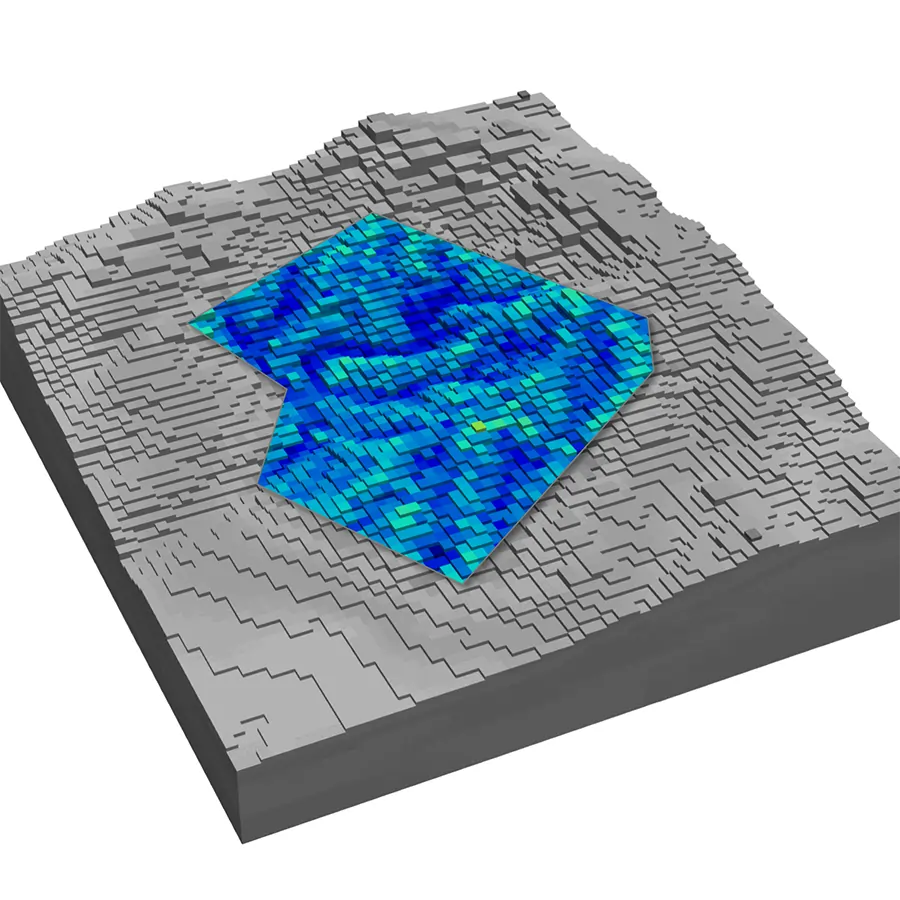
We note that the match to the observed data isn't perfect, but that's okay because at this stage we only care about the first-order structural features. What's important is that we've narrowed the space of possibilities to what you see below.
We now have a concrete, quantitative understanding of where the source of this anomaly could be. But this is only half the picture - we now need to take action.
Optimizing a Drilling Strategy
The main benefit of the probabilistic inversion described in the preceeding section is that we have a quantitative backbone for making risk-adjusted decisions about where to deploy capital into the ground. In other words, we can optimize a drilling strategy to give ourselves the best chance of intersecting the source of the anomaly.
ExploreTech ran a drilling optimization routine assuming a budget of 1-2 drillholes, each up to 1500m long. Drill pads were constrained to the parts of the property accessible for a drill rig.
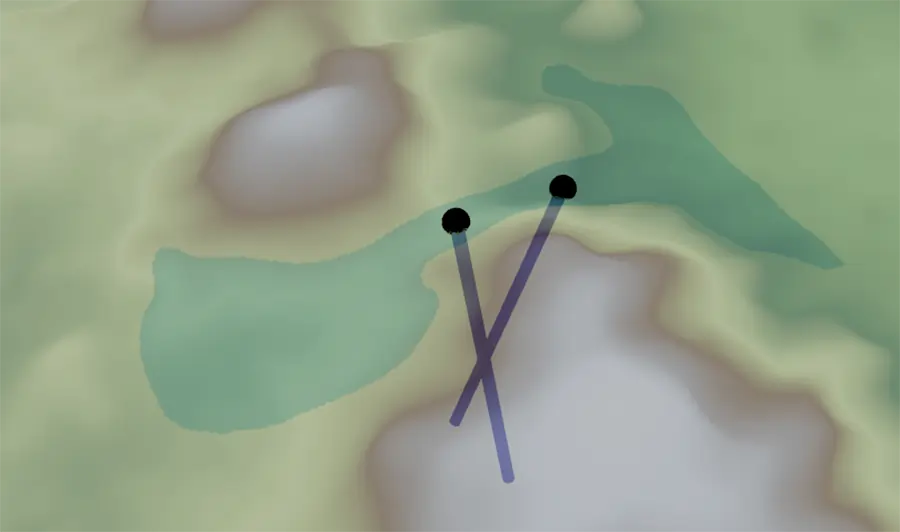
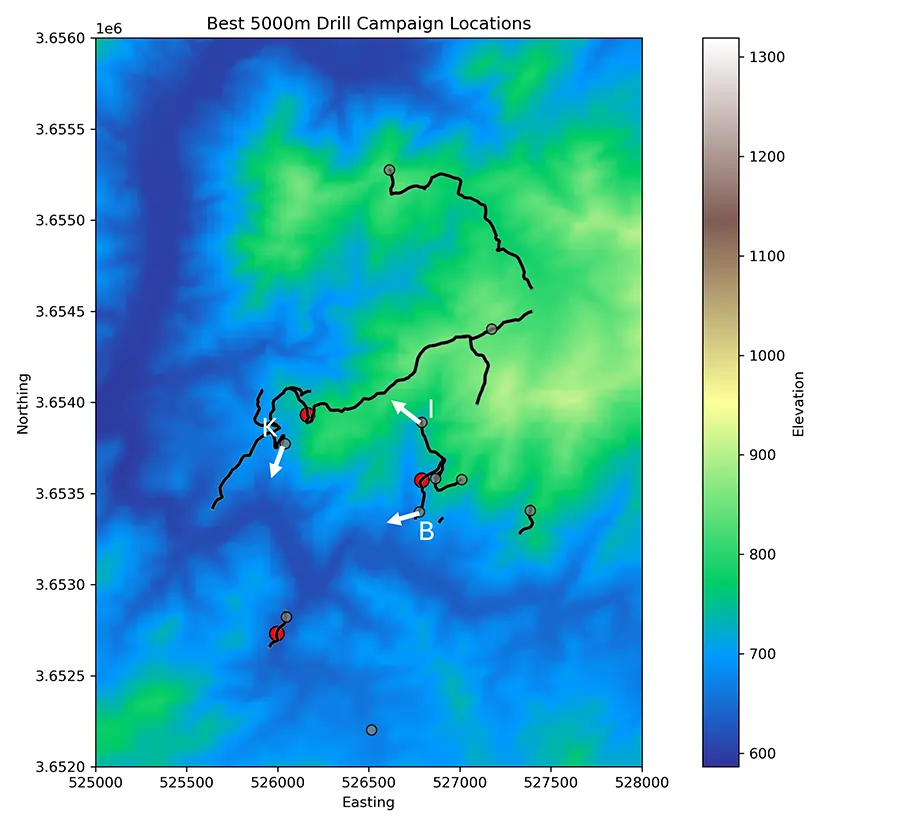
ExploreTech delivered two drill strategies: a single-drillhole plan and a two-drillhole plan. The optimization workflow was run on the ExploreTech Engine. The two optimized drill plans are shown below.
Thousands of drill plans are simulated, and fit to Reyna Silver's preference for campaign depth, locations, etc. In this case, we output two drill plans. See the Prismo Metals case study for more demonstrations on simulating thousands of drill plans.
Unfortunately, a shifting geopolitical landscape in Mexico resulted in an indefinite pause on drilling, so these results were never confirmed.
Concluding Thoughts
Although the anomaly hasn't been drill tested yet, this case study shows how probabilistic geophysical inversions and drilling optimization can provide quantitative insights into early-stage exploration drilling.
Further Reading
-
 Reyna Silver
Finding the Source Intrusion and Optimizing Drill Planning
Reyna Silver
Finding the Source Intrusion and Optimizing Drill Planning
-
 Prismo Metals
ZTEM inversion in Search of a Porphyry Copper Deposit
Prismo Metals
ZTEM inversion in Search of a Porphyry Copper Deposit
-
 Scout Discovery Corp
High Resolution Inversion of Copper Porphyry
Scout Discovery Corp
High Resolution Inversion of Copper Porphyry
Further Reading - List Example
- Reyna Silver Finding the Source Intrusion and Optimizing Drill Planning
- Prismo Metals ZTEM inversion in Search of a Porphyry Copper Deposit
- Scout Discovery Corp High Resolution Inversion of Copper Porphyry
Further Reading - Card Example
Further Reading
-
Reyna Silver
Finding the Source Intrusion and Optimizing Drill Planning -
Prismo Metals
ZTEM inversion in Search of a Porphyry Copper Deposit -
Scout Discovery Corp
High Resolution Inversion of Copper Porphyry